
This week I worked on large scale terrain generation. The plan is run an environment simulation for some amount of time to create large scale structures (such as lakes, rivers, and mountains). The actual game will then use the large scale features as a guide for more detailed generation.
I'm using a different algorithm to generate the elevation. Specifically, I'm using the idea described on this page. I like this algorithm a lot because it's very simple and produces good results. Compare a planet created with Perlin noise vs. the spherical landscape algorithm:
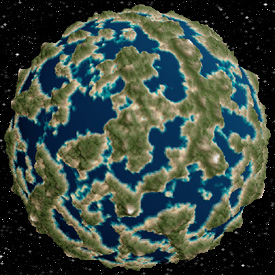 |
| Using Perlin noise. |
 |
| Using spherical landscape. |
Perlin noise tends to be more uniform resulting in a planet covered in lakes. While this can be overcome by adding multiple noise layers together, there are a lot more variables that need adjusting to get it looking good. With the spherical landscape algorithm, on the other hand, you need only to adjust the number of iterations. It tends to produce more varied results, which look more like oceans and continents.
Currently, the environment simulation works by iterating on several layers of 'fluid'. I use this term loosely because what I'm doing is not at all physically accurate (and I'm applying it to soil and sand in addition to water). The bottom-most layer is rock. Rock doesn't flow at all, but it can be eroded, which results in sand. Sand resists flow more than water, and soil more than sand, which creates flat-lands and beaches. Rain is simulated by evaporating water from every point and redistributing it equally.
The environment simulation is pretty bare bones at the moment, but it's already producing good results. I'll probably continue working to make it better for a few weeks before using it to generate actual game terrain.
Currently, the environment simulation works by iterating on several layers of 'fluid'. I use this term loosely because what I'm doing is not at all physically accurate (and I'm applying it to soil and sand in addition to water). The bottom-most layer is rock. Rock doesn't flow at all, but it can be eroded, which results in sand. Sand resists flow more than water, and soil more than sand, which creates flat-lands and beaches. Rain is simulated by evaporating water from every point and redistributing it equally.
The environment simulation is pretty bare bones at the moment, but it's already producing good results. I'll probably continue working to make it better for a few weeks before using it to generate actual game terrain.

